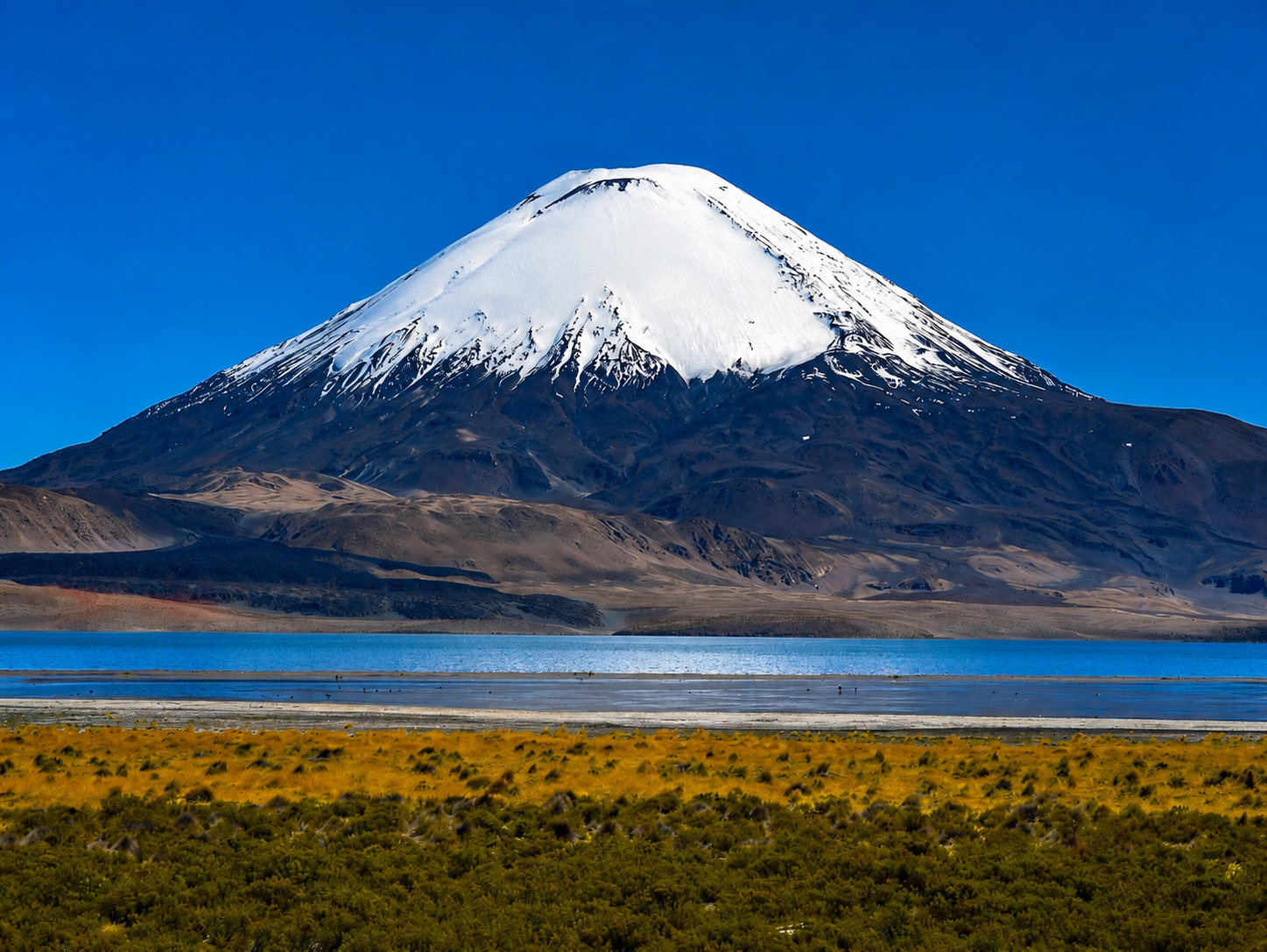
VOLCÁN PARINACOTA6,342 m
8 days on the Chilean altiplano to climb the north face of Volcán Parinacota (6,342 m / 20,807 ft) — a perfect volcanic cone above the bofedales of Caquena, on the classic normal route from Chile.
Duration
8 days
Grade
Intermediate · High Altitude
Altitude
3,600 – 6,342 M (20,807 FT)
Season
MAY – DECEMBER (ALTIPLANO DRY SEASON)
(01) Overview
The perfect cone of the altiplano.
Volcán Parinacota rises to 6,342 m / 20,807 ft on the border between Chile and Bolivia, in the Región de Arica y Parinacota. Together with its twin Pomerape it forms the Nevados de Payachata — "the twin brothers" in Aymara — one of the most photographed skylines in the Andes, reflected in the waters of Lago Chungará and the bofedales of Lauca National Park.
The normal route · north face from Chile We climb the classic Ruta Normal on the north face, approached from the Chilean side. From Putre (3,600 m) the road crosses the altiplano past the village of Parinacota towards Caquena, where the team registers with Carabineros before heading to Rinconada, at the southern edge of the Caquena bofedal. From there a long walk over volcanic sand leads to high camp at the snow line, and from high camp the route wraps around the cone to the east before rising directly to the crater rim.
A non-technical but demanding climb Being an almost perfect cone, the route is obvious: always up, heading south. Slopes start around 30° and steepen to 45–50° near the crater. Crampons and ice axe are used throughout the summit day, both for security on hard snow and for self-arrest. In dry seasons there can be open crevasses below the crater rim, and late in the season penitentes make the ascent slower. Summit day is long — 6 to 8 hours up and 3 to 4 hours down — so we leave well before dawn to return in daylight.
Acclimatization The altiplano demands respect: a minimum of five days above 4,000 m before the summit push is our standard. The program uses Putre as an acclimatization base with day hikes, then progressively higher nights at the bofedal camp and at high camp near the snow line.
Aymara culture and Lauca National Park The expedition unfolds inside one of Chile's most striking cultural landscapes: the colonial church of Parinacota village, vicuñas and llamas grazing the bofedales, flamingos on Lago Chungará at 4,500 m, and Aymara herding communities that have lived on this plateau for centuries.
Activities and Risks High-altitude mountaineering, snow travel with crampons and ice axe, long approaches over volcanic sand, 4x4 travel and tent camping. Risks include extreme cold (temperatures can drop to −35 °C), high winds, intense UV exposure, altitude illness, crevasses in dry years and remote, isolated terrain.
(02) Highlights
Trip highlights.
- 01Summit of Volcán Parinacota (6,342 m / 20,807 ft) by the normal route on the north face
- 02The Payachata twins — Parinacota and Pomerape — above the Caquena bofedal
- 03Acclimatization based in Putre (3,600 m), the gateway to the altiplano
- 04Lago Chungará (4,500 m), flamingos, vicuñas and Lauca National Park
- 05The Aymara village of Parinacota and its 17th-century colonial church
- 06A contingency day reserved for the summit weather window
(03) Day by day
Itinerary.
- Day 01ARICA · PUTRE
Arrival in Arica on the Pacific coast, team meeting and gear check. Drive up Route 11 to Putre (3,600 m), the main acclimatization base of the altiplano. Light walk around the village, hydration and rest.
- Day 02ACCLIMATIZATION · PUTRE
Acclimatization hike on the hills above Putre, gaining around 600–800 m before descending to sleep low. Afternoon briefing on altitude physiology, hydration and the route ahead.
- Day 03LAGO CHUNGARÁ · PARINACOTA VILLAGE
Excursion into Lauca National Park: Lago Chungará at 4,500 m with the full view of the Payachata twins, flamingos and vicuñas, and a visit to the Aymara village of Parinacota and its colonial church. Return to Putre for the night.
- Day 04CAQUENA · RINCONADA BASE CAMP
Drive across the altiplano towards Caquena, where the expedition registers with Carabineros as required. Continue by 4x4 along the western edge of the bofedal to Rinconada. Base camp is set up here at around 4,400 m with water carried in — the bofedal water is not drinkable.
- Day 05HIGH CAMP · SNOW LINE
The long approach day: roughly 7 hours of walking over volcanic sand from Rinconada towards the base of the cone, with the volcano always in sight. High camp is established close to the snow line (around 5,200–5,400 m) to have water available. Snow skills review: crampons, ice axe and self-arrest.
- Day 06SUMMIT DAY · PARINACOTA
Pre-dawn start from high camp. The route first wraps around the cone to the east, then climbs directly south towards the summit. Slopes of 30° steepen to 45–50° in the final section, reaching the rim of the immense crater after 6 to 8 hours; we follow the rim right to the highest point at 6,342 m. Descent of 3 to 4 hours back to high camp.
- Day 07CONTINGENCY / DESCENT TO PUTRE
Reserve day held for weather or a second summit attempt. If the summit was reached on Day 6, the team packs high camp and descends to Rinconada and back to Putre for a celebration dinner and a night at lower altitude.
- Day 08PUTRE · ARICA
Descent from the altiplano to Arica, transfer to the airport or the coast. End of program.
(04) Logistics
What's included.
Included
- +Certified mountain guides at a 1:4 guide-to-climber ratio
- +All in-country ground transport from Arica, including 4x4 altiplano transfers
- +Accommodation in Putre and all camps on the mountain
- +All meals from Day 1 to Day 8, plus drinking water carried to base camp
- +Park access fees, Caquena registration and climbing permits
- +Group technical gear: tents, cooking and dining tent, ropes, radios
- +Supplementary oxygen, medical kit and satellite communications
Not included
- −International and domestic flights to Arica
- −Extra nights of accommodation not specified in the itinerary
- −Meals and drinks in Arica
- −Travel insurance, including medical evacuation and trip cancellation
- −Personal climbing gear per the recommended Gear List
- −Any costs associated with early departure from the expedition
(05) Gear & safety
Gear
- High-altitude mountaineering boots plus step-in crampons and a walking ice axe.
- Layered clothing system: base layers, insulating synthetic or down layers, and a waterproof GORE-TEX shell jacket and pants. No cotton.
- Glove system: liner, midweight and expedition mitts. Balaclava, buff and warm hat — the altiplano can reach −35 °C.
- Category 4 glacier glasses and goggles, high-factor sunscreen and lip protection.
- Sleeping bag rated to −20 °C, insulated sleeping pad and down parka.
- Backpack 55–65 L, trekking poles and harness. Detailed gear list sent after registration.
Safety
- Certified high-altitude guides with a 1:4 ratio and Wilderness First Responder training
- Minimum five days of acclimatization above 4,000 m before the summit push
- Daily health checks: oxygen saturation, heart rate and symptom monitoring
- Expedition registration with Carabineros in Caquena, as required on this route
- Supplementary oxygen, medical kit, radios and satellite communications
- Coordinated evacuation protocol — travel insurance with medical evacuation is mandatory
(06) FAQ
Questions.
Do I need previous mountaineering experience?+
Basic snow experience is recommended but not mandatory. The route is non-technical: there is no rock or ice climbing, but you must be comfortable walking with crampons and an ice axe on slopes up to 45–50°, and be in excellent physical condition. We review all snow skills at high camp.
When is the best season?+
Between May and December. The winter months offer the most stable weather and well-consolidated snow. We avoid the "Bolivian winter" (January–February), when the altiplano turns unstable and rainy, and very late season, when penitentes make the climb much harder.
How cold does it get?+
Very cold. Night temperatures on the altiplano and at high camp can drop to −35 °C with wind chill, which is why the clothing and sleeping system in the gear list is non-negotiable.
How much does the program cost?+
The price depends on the size of your group and the dates chosen — larger groups get lower per-person rates. Contact us with your group size and preferred dates and we will send a detailed quotation.
Is this trip suitable for a university outdoor club?+
Yes. It works very well as a first 6,000 m objective for a well-prepared club team, and combines mountaineering with Aymara culture and the ecology of Lauca National Park.
(07) Request this expedition
Ready for the Chilean Altiplano?
Tell us your group size, target dates and objectives. Our basecamp team replies within 48 hours with a tailored proposal.