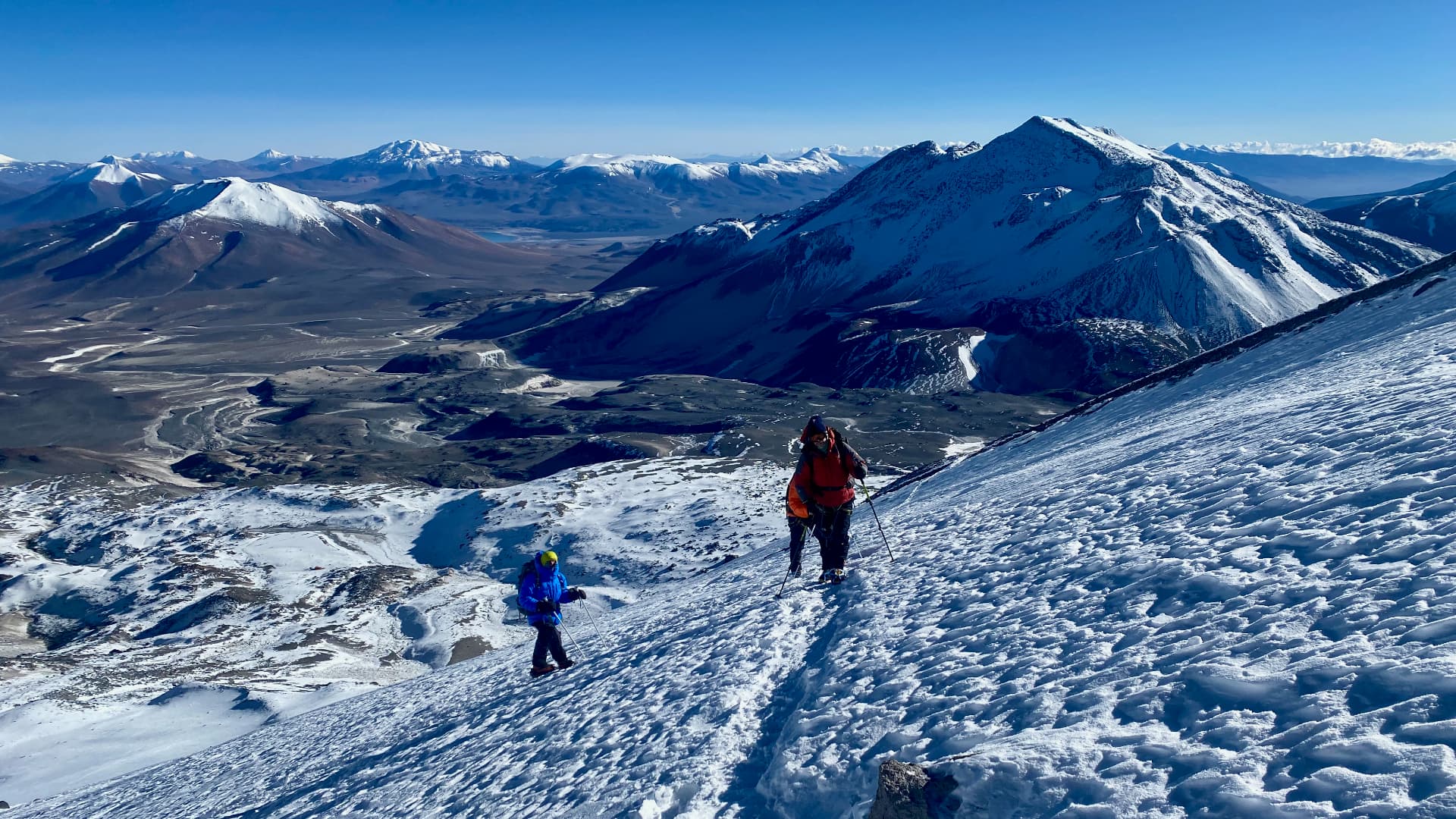
OJOS DEL SALADO6,890 m
12 days in the Atacama highlands to climb the highest volcano on Earth (6,890 m / 22,608 ft) — a progressive, fully supported ascent from Copiapó to the summit.
Duration
12 days
Grade
Advanced · Extreme Altitude
Altitude
3,700 – 6,890 M (22,608 FT)
Season
NOVEMBER – MARCH (AUSTRAL SUMMER)
(01) Overview
The highest volcano on Earth — Ojos del Salado.
Ojos del Salado is the highest active volcano in the world, rising to 6,890 m / 22,608 ft over the Atacama altiplano on the border between Chile and Argentina. It is also the second highest mountain in the southern hemisphere, only some 60 m lower than Aconcagua.
"The Eyes of Salt" The name describes the round salt lagoons scattered across the flanks of the volcano, where flamingos feed on algae and krill. At 4,400 m, Laguna Verde is a thermal spring heated by the volcanic activity of the area — one of the best rest and acclimatization spots on the mountain. The crater lake near the summit, at roughly 6,390 m, is the highest lake in the world.
A remote peak in the driest desert on Earth The expedition unfolds entirely in the Atacama altiplano: salt flats, high-altitude lagoons, volcanic plateaus and roads that climb above 5,000 m. Vehicle access to Refugio Atacama (5,200 m) means the team can focus on acclimatization and the climb itself instead of long approach marches, while still operating in one of the most isolated mountain environments in the world.
Acclimatization strategy The 12-day itinerary is built around a progressive "climb high, sleep low" schedule: nights at Laguna Santa Rosa (3,700 m), an acclimatization ascent of Cerro Siete Hermanos (4,780 m), several nights at Laguna Verde (4,200 m), a carry day to Refugio Tejos (5,800 m) and a full rest day at Refugio Atacama before the summit push. Two extra days are reserved for the weather window.
Activities and Risks High-altitude mountaineering, snow and penitente travel, scrambling on rock ridges, 4x4 travel and refuge/tent camping. Risks include extreme cold and wind, intense UV exposure, altitude illness, isolated travel and loose rock.
Difficulty No previous technical climbing experience is required, but climbers must be in excellent physical condition and should have prior experience above 5,000 m. Summit day is long — 10 to 14 hours — on mixed rock, snow and a steep final headwall.
(02) Highlights
Trip highlights.
- 01Summit of Ojos del Salado (6,890 m / 22,608 ft), the world's highest volcano
- 02Acclimatization ascent of Cerro Siete Hermanos (4,780 m)
- 03Laguna Verde thermal springs and flamingo-filled salt lagoons
- 04Carry day to Refugio Tejos (5,800 m), one of the highest refuges on Earth
- 05Full 4x4 logistics and refuge support at 5,200 m
- 06Two extra days reserved for the summit weather window
(03) Day by day
Itinerary.
- Day 01COPIAPÓ · LAGUNA SANTA ROSA
Arrival in Copiapó, team meeting and gear check. Drive up to Laguna Santa Rosa (3,700 m) in the Nevado Tres Cruces National Park. First night at altitude, hydration and rest.
- Day 02CERRO SIETE HERMANOS
Acclimatization ascent of Cerro Siete Hermanos (4,780 m) from Laguna Santa Rosa, applying the "climb high, sleep low" principle. Return to Laguna Santa Rosa for the night.
- Day 03LAGUNA VERDE
Transfer across the altiplano to Laguna Verde (4,200 m), a turquoise salt lagoon with natural thermal springs at its shore. Afternoon rest, hydration and evening soak in the hot springs.
- Day 04ACCLIMATIZATION TREK · LAGUNA VERDE
Full acclimatization day around Laguna Verde with a trek on the surrounding slopes. Skills review: use of crampons and ice axe, rope handling and fixed-line technique. Overnight at Laguna Verde.
- Day 05REFUGIO ATACAMA
Drive by 4x4 up to Refugio Atacama (5,200 m), the mountain's advanced base. Camp/refuge setup, light walk around the refuge, hydration and early night.
- Day 06REFUGIO TEJOS · CARRY DAY
Ascent to Refugio Tejos (5,800 m) to carry loads and acclimatize, then descent back to Refugio Atacama to sleep low. A key day for the body to adapt before the summit push.
- Day 07REST DAY AT REFUGIO ATACAMA
Full rest and recovery day at 5,200 m: hydration, nutrition, gear preparation and weather-window planning with the guide team.
- Day 08SUMMIT DAY · OJOS DEL SALADO
Pre-dawn departure from Refugio Atacama. Ascent past Refugio Tejos, across snow and penitente fields and up the final steep summit headwall — protected with a fixed rope — to the summit at 6,890 m. Views over the crater lake and the entire altiplano before descending back to Refugio Atacama.
- Day 09DESCENT · COPIAPÓ / BAHÍA INGLESA
Pack up the refuge and descend by 4x4 to Copiapó, with the option of continuing to the coast at Bahía Inglesa. Celebration dinner and a night at low altitude.
- Day 10EXTRA DAY
Reserve day held for weather, a second summit attempt or additional rest, depending on how the expedition unfolds.
- Day 11EXTRA DAY
Second reserve day. If not needed on the mountain, it is used for rest on the coast at Bahía Inglesa or optional excursions in the Atacama.
- Day 12COPIAPÓ · SANTIAGO
Transfer to Copiapó and flight back to Santiago. End of program.
(04) Logistics
What's included.
Included
- +Certified mountain guides at a 1:3 guide-to-climber ratio
- +All in-country ground transport, including 4x4 mountain transfers
- +All meals, refuges and camps from Day 1 to Day 12
- +Permits and park access fees (Nevado Tres Cruces National Park and Ojos del Salado)
- +Group technical gear: tents, cooking and dining tent, fixed ropes, radios
- +Refuge oxygen, medical kit and satellite communications
Not included
- −International flights and domestic flights to Copiapó
- −Extra nights of accommodation not specified in the itinerary
- −Meals and drinks in Copiapó, Bahía Inglesa and Santiago
- −Travel insurance, including medical evacuation and trip cancellation
- −Personal climbing gear per the recommended Gear List
- −Any costs associated with early departure from the expedition
(05) Gear & safety
Gear
- Double mountaineering boots rated for 6,000 – 7,000 m peaks, plus step-in crampons.
- Layered clothing system: base layers, insulating synthetic or down layers, and a waterproof GORE-TEX shell jacket and pants. No cotton.
- Glove system: liner, midweight and expedition mitts. Balaclava, buff and warm hat.
- Category 4 glacier glasses and goggles, high-factor sunscreen and lip protection.
- Sleeping bag rated to −25 °C, insulated sleeping pad and expedition down parka.
- Backpack 55–65 L, trekking poles, ice axe and harness. Detailed gear list sent after registration.
Safety
- Certified high-altitude guides with a 1:3 ratio and Wilderness First Responder training
- Progressive acclimatization schedule with two extra reserve days
- Daily health checks: oxygen saturation, heart rate and symptom monitoring
- Supplementary oxygen and comprehensive medical kit at the refuge
- Satellite communications and radios with 24/7 check-in
- Coordinated evacuation protocol — travel insurance with medical evacuation is mandatory
(06) FAQ
Questions.
Do I need previous mountaineering experience?+
No technical rock or ice climbing experience is required, but you should have prior experience above 5,000 m and be in excellent physical condition. Good options to build that experience beforehand are our Andes Climb (Cerro El Plomo) and Cotopaxi programs.
How high is Ojos del Salado exactly?+
6,890 m / 22,608 ft. It is the highest active volcano in the world and the second highest peak in the southern hemisphere, only about 60 m lower than Aconcagua.
How is the 12-day itinerary structured?+
The program builds altitude gradually: Laguna Santa Rosa (3,700 m), an acclimatization ascent of Cerro Siete Hermanos (4,780 m), Laguna Verde (4,200 m) with a trekking day, Refugio Atacama (5,200 m), a carry day up to Refugio Tejos (5,800 m), a rest day, and then the summit push on Day 8. Days 10 and 11 are extra days reserved for weather or a second attempt.
How much does the program cost?+
The price depends on the size of your group and the dates chosen — larger groups get lower per-person rates. Contact us with your group size and preferred dates and we will send a detailed quotation.
What are the chances of summiting?+
Ojos del Salado is non-technical but the weather and wind are the deciding factors. That is why the itinerary includes two extra days — they significantly increase the chance of finding a good summit window.
(07) Request this expedition
Ready for the Atacama Highlands?
Tell us your group size, target dates and objectives. Our basecamp team replies within 48 hours with a tailored proposal.